

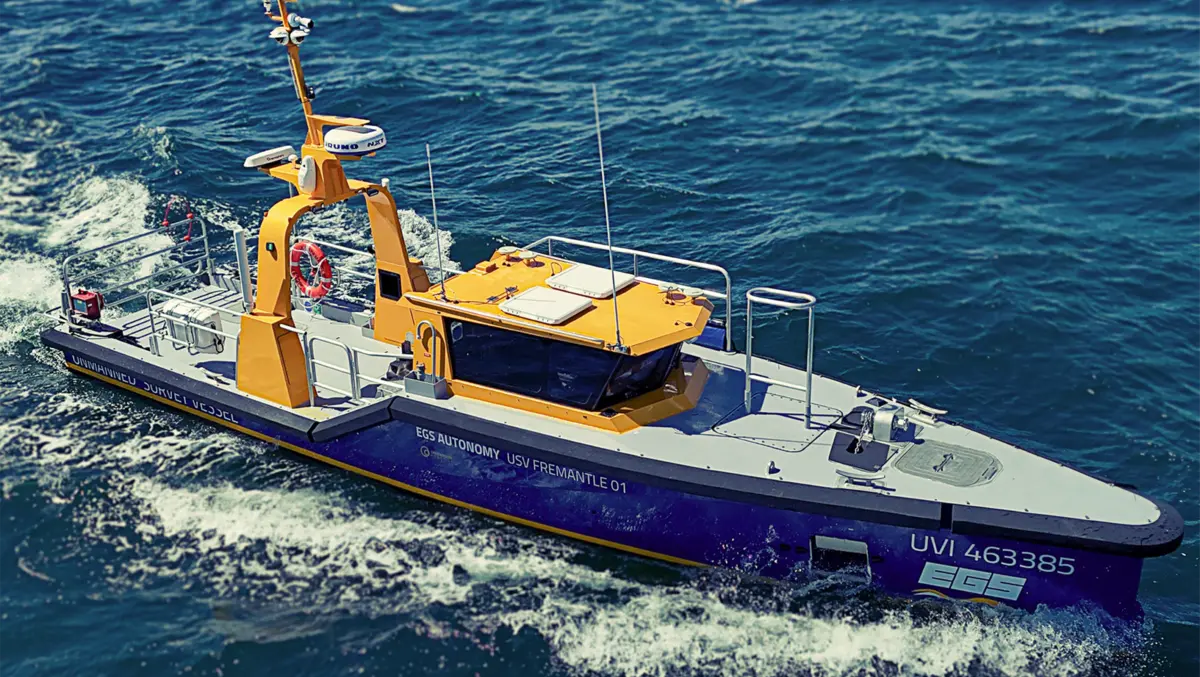
Uncrewed vessel surveys subsea cable route off WA coast
Fri, 20th Feb 2026.webp)
OMS Group and EGS Australia have completed a subsea cable route survey off Western Australia using an uncrewed survey vessel, as developers test more autonomous platforms in offshore environments.
The work used EGS Australia's uncrewed survey vessel Fremantle 01, which carried out geophysical survey activity without an onboard crew.
Interest in uncrewed systems has grown as project schedules tighten and offshore risk management remains in focus. Cable projects often require detailed seabed data for route selection and engineering, including in nearshore zones where weather, sea state, and vessel traffic can constrain operations.
The operation demonstrates how unmanned platforms can be used in the subsea cable sector and marks a step toward wider adoption of uncrewed survey methods on cable developments.
Safety And HSE
For offshore contractors, the most immediate driver for uncrewed survey work is workforce safety. Removing personnel from the vessel avoids exposure to hazards associated with marine operations, including transits, deck work, and extended time at sea.
OMS Group and EGS Australia said the lack of an onboard crew reduced personnel exposure to offshore risks. They also pointed to the ability to keep operations running in difficult offshore and nearshore conditions.
"This project reflects our commitment to embracing innovative technologies that enhance safety, efficiency, and sustainability across our subsea operations," said Ronnie Lim, Group CEO at OMS Group. "Autonomous solutions such as this provide valuable complementary capabilities to conventional survey approaches, particularly for complex offshore environments."
Vessel Endurance
EGS Australia's Fremantle-class USV has a stated range of 2,000 nautical miles and an endurance of up to 15 days between services. That profile suits survey campaigns that need extended time on task and fewer port calls, particularly in remote coastal areas where logistics can add cost and complexity.
The companies said the project improved operational efficiency while maintaining the data quality required for subsea cable development. Cable route surveys typically need consistent, repeatable acquisition because the data feeds into route engineering and later installation planning.
They also linked uncrewed operations to lower fuel use and reduced marine disturbance, positioning the platform as part of a broader push for lower-emission delivery models across marine infrastructure projects. In subsea cable work, sustainability expectations have increased as developers face greater scrutiny of marine impacts and vessel emissions during survey and installation.
Market Context
Cable route surveys are an early stage of new subsea cable developments and system upgrades. The work can include bathymetry and sub-bottom profiling, along with hazard identification across the proposed corridor. Results influence later decisions on route alignment, burial depth, and installation methodology.
The Western Australia deployment reflects a wider shift toward autonomy in offshore operations. Hydrographic and geophysical survey providers have expanded the use of remote and uncrewed platforms in recent years, particularly for nearshore work and repeat surveys where smaller craft can operate with fewer constraints than larger crewed vessels.
OMS Group and EGS Australia said they view autonomous and uncrewed technologies as complementary to conventional vessels rather than a complete replacement. Many project teams take a similar approach, using uncrewed systems for specific scopes such as corridor reconnaissance, environmental monitoring, and targeted geophysical lines, while reserving crewed vessels for heavier payloads or complex offshore tasks.
"EGS have been at the forefront of global subsea cable route surveying advances since the 1990s," said Charles Collins, chief surveyor at EGS Australia. "We are thrilled to once again be leading the way with the development of our own USV, tailored specifically to geophysical survey on the continental shelf. EGS' global network of offices and facilities will allow us to base Fremantle-class USVs strategically in each region internationally soon. We thank OMS for this first opportunity to prove our technology and look forward to collaborating in the future."
OMS Group provides telecommunications infrastructure services, including submarine cable installation support and marine maintenance, as well as interconnect managed services such as cable landing stations and network backhaul. EGS Australia is part of EGS Group and provides hydrographic and geophysical survey services across sectors including energy, telecommunications, ports, and shipping.
The companies said further use of uncrewed systems is likely as survey contractors add platforms and clients gain more experience with autonomous operations across different marine conditions.