

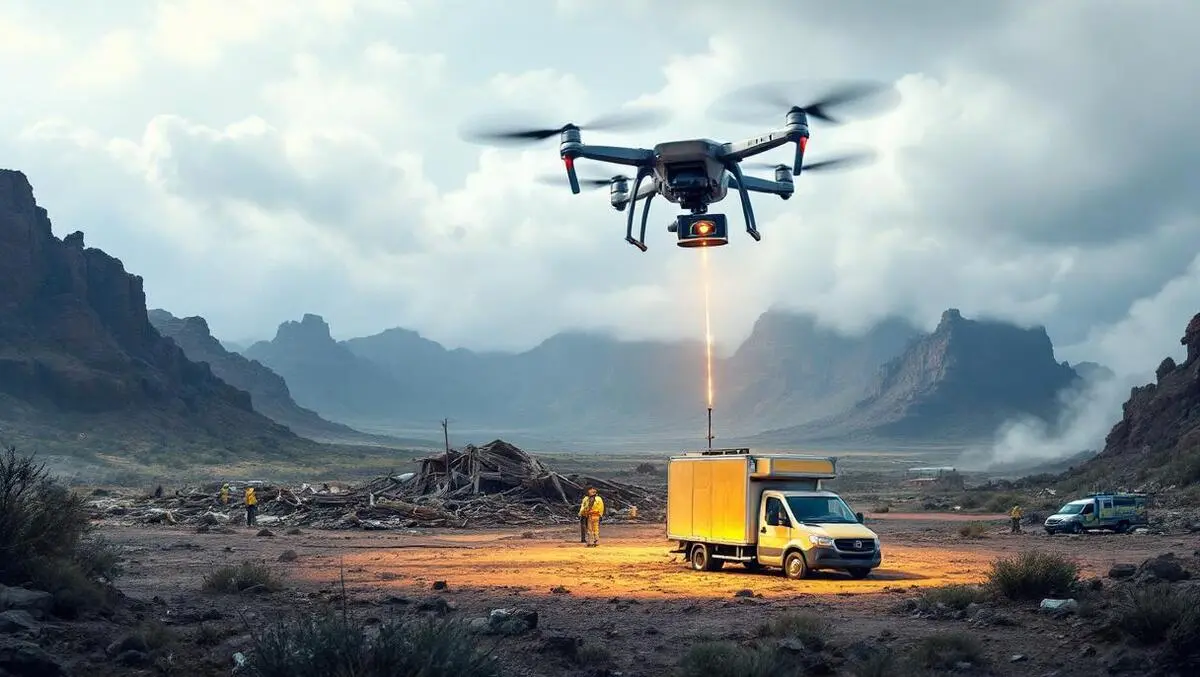
Drones & small cells trialled to restore phone networks in disasters
Fri, 29th Aug 2025
Optus and Nokia have partnered to trial new drone-based network solutions aimed at quickly restoring mobile connectivity in the aftermath of natural disasters.
This collaboration follows a series of mobile network outages experienced by customers during ex-Tropical Cyclone Alfred, where power loss and flooding disrupted communications and highlighted the need for more flexible emergency response options.
Optus and Nokia have developed a telecommunications payload solution that can be deployed using the EON800 Tether Drone System, designed and produced by Melbourne-based XM2, as well as a compact portable small cell. Both solutions are intended to provide rapid restoration of voice and data services to affected areas.
Small cell solution
Nokia's compact small cell technology is engineered to be lightweight and easy to deploy. It can be positioned on a tripod or pole and establishes a connection via a Low Earth Orbit (LEO) satellite back to the operator's core network, allowing it to function independently without requiring nearby mobile towers. This capability focuses on re-establishing basic connectivity for users within disaster zones where ground-based infrastructure is compromised or unavailable.
The small cell solution has the capacity to reinstate both voice and data services swiftly in disaster-impacted regions, supporting communication between local residents, emergency services and authorities.
Tether drone telecommunications
To further extend coverage, the EON800 Tether Drone System - integrated with Optus and Nokia's telecommunications payload - can deliver 4G and 5G coverage, including voice and SMS services, within an approximate 2-kilometre radius for multiple handsets. Data connectivity speeds of up to 100 Mbps have been observed in demonstration environments.
The tethered drone system provides 4,500 W of continuous power and high-speed fibre connectivity to a heavy-lift platform, supporting up to 15 kg of payload. It is capable of sustained operations at altitudes as high as 120 metres for up to seven days, ensuring ongoing service delivery even in remote locations.
This drone system is powered from the ground station, enabling continuous 24-hour operation without the need for recharging - deemed an essential feature for emergency response, temporary accommodation zones, or recovery operations where network infrastructure is absent.
Testing at Macquarie University
Both the small cell and tethered drone network solutions have been tested at Macquarie University. The tests included a live demonstration featuring a Nokia AirScale Micro-RRH small cell mounted on a drone, paired with a 4x4 MIMO omni-directional antenna. The demonstration established 5G standalone private wireless coverage in the test area, using Nokia's Digital Automation Cloud (DAC) and Mission Critical Industrial Edge (MXIE) solutions to enable critical communications facilitated via the Nokia Teams Comm application.
A Nokia 360 5G camera, also mounted on the drone, integrated with Nokia's Real-time eXtended Reality Multimedia (RXRM) software, provided efficient, low-latency live video stream feeds to multiple endpoint devices such as TVs, tablets, and VR headsets, supporting emergency communication and situational awareness needs.
The demonstrations illustrated support for critical communications and real-time assessment for emergency services and first responders in disaster-hit areas.
Stakeholder perspectives
Tony Baird, Optus Chief Technology Officer, Networks, commented on the potential role these technologies could play in disaster preparedness and response.
"The solution I'm seeing today with the tethered drone, with the tripod mounted small cell gives me confidence that we are seeing some more innovation we can use in our network."
Optus is now evaluating the integration of these solutions into its operational disaster response plans following the successful demonstration.
Jae Won, Senior Vice President and Head of APAC, Mobile Networks at Nokia, said:
"With natural disasters unfortunately occurring more frequently, we have an obligation as technology companies to help prepare for and mitigate the impact. Connectivity is absolutely critical in these situations. The drone-based setup using private wireless we demonstrated with Optus can restore connectivity quickly, helping blue light organisations act fast and save lives."
Stephen Oh, Chief Executive Officer of XM2, stated:
"XM2 are proud to see the EON800 Tether Drone System playing an expanding role in disaster response across Australia and globally. Since its development began in 2021, the technology has continually advanced, enabling companies like Optus and Nokia to leverage it for delivering rapid, reliable connectivity during emergencies. This highlights the real-world impact of the system in helping communities stay connected when it matters most and ultimately saving lives."
The trials demonstrate the potential for tethered drone telecommunications and portable small cells to form part of future telecommunications disaster response strategies, to support communities with critical connectivity during emergencies.