

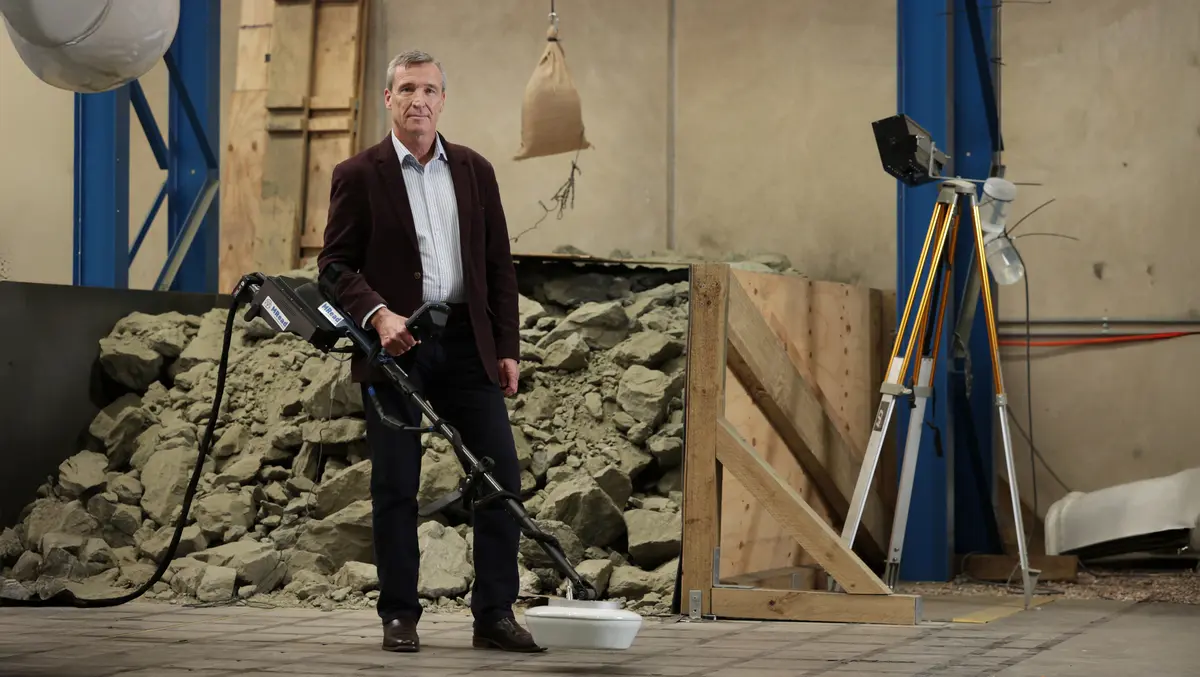
MRead wins AUD $1.6m grant for handheld landmine scanner
Tue, 23rd Dec 2025
Australian deep-tech company MRead has secured a AUD $1.6 million grant under the federal Industry Growth Programme for the development of a handheld landmine detector that identifies explosives by their molecular signature rather than metal content.
The company is developing the MineReader device in collaboration with the national science agency CSIRO and commercialisation partner RFC Ambrian. MineReader applies magnetic resonance technology similar to that used in MRI scanning. It detects the molecular signature of explosives such as TNT and RDX.
The developers state that this approach will reduce false alarms during demining operations. They also expect it to increase the speed of landmine clearance in heavily contaminated regions.
"Landmines are one of the great unresolved global challenges," said CEO John Shanahan, CEO, MRead. "Our technology promises to save lives and return land to communities faster and more safely."
The Industry Growth Programme funding will support the final phase of engineering and design work on MineReader. This phase includes power and signal optimisation and integration of the technology into a field-ready product.
MRead plans large-scale trials of MineReader in Angola in 2026. The company has partnered with humanitarian demining organisation The HALO Trust for these trials.
Chief Technology Officer Dr Nick Cutmore said the grant would directly affect the pace of development.
"This funding will allow us to fast-track the next stage of development and take MineReader from prototype to a rugged, field-ready product," said Dr Nick Cutmore, Chief Technology Officer, MRead. "Our goal is to make landmine detection faster, safer and more accurate for deminers working in extremely difficult conditions."
MRead completed its first set of trials in Angola in 2024. Those trials focused on detecting RDX-based landmines using the magnetic resonance approach.
The company is now preparing for a shift from prototype development to commercialisation. The next phase of work will focus on establishing commercial manufacturing arrangements and preparing for first sales, which MRead targets for 2026.
Merger and capital raise
The grant follows a broader restructuring of the business through a merger and capital raising. MRead has combined with mining technology firm NextOre to form a new holding company, MagnaTerra Technologies.
The merged entity has raised AUD $11 million from institutional and strategic investors. MagnaTerra's backers include CSIRO, RFC Ambrian, Codan and Worley.
MagnaTerra now presents itself as a specialist in magnetic resonance sensing across multiple sectors. These sectors include humanitarian demining, critical minerals, defence and border security.
The new company retains both operating brands. MRead focuses on demining, security and defence products. NextOre continues to serve the mining sector.
Shanahan now serves as Chief Executive of both MRead and MagnaTerra. He said the combination of the two businesses created a broader commercial platform.
"MagnaTerra consolidates world-leading science, engineering and commercial momentum into a single platform with global reach," said Shanahan.
RFC Ambrian Chair Rob Adamson will chair the MagnaTerra board. He described the merged company as a domestic technology platform with established revenue and intellectual property.
"MagnaTerra is a sovereign tech platform with real revenue, high-impact IP, and global applications - from making mining more efficient to saving lives in conflict zones," said Adamson.
MagnaTerra applies non-invasive magnetic resonance sensing to identify and analyse specific compounds in real time. The technology has applications in analysis of minerals, explosives and narcotics.
In mining, the group uses magnetic resonance sensing for ore sorting and grade control. In security and defence, the same core science underpins solutions for explosives detection and cargo or border screening.
With the Industry Growth Programme grant in place, MRead is moving MineReader through final engineering steps and into operational trials. Large-scale field testing with The HALO Trust in Angola is scheduled ahead of anticipated commercial deployment from 2026.