

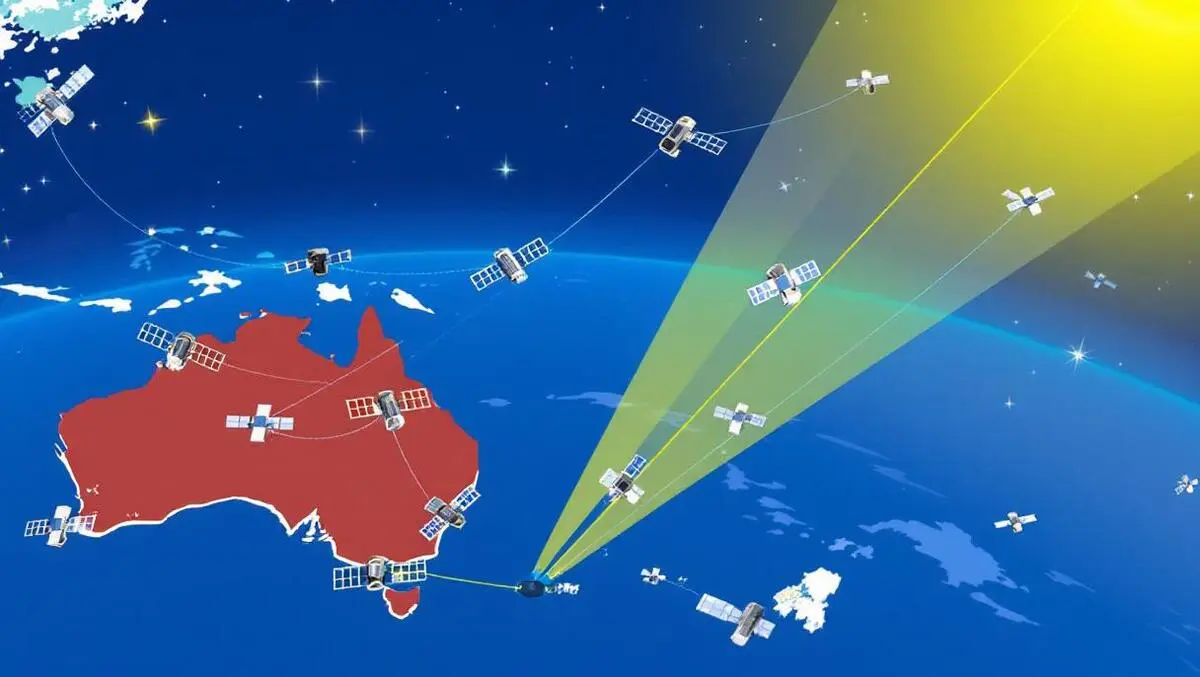

Australian spending on low Earth orbit (LEO) satellite communications services is forecast to reach AUD $664 million in 2026, according to projections by technology research firm Gartner.
This anticipated growth represents a 6.6% increase from 2025, with LEO satellite services moving beyond their initial uses in rural and regional Australia to become more widely adopted for both business and consumer applications.
According to Khurram Shahzad, Senior Director Analyst at Gartner, "LEO satellites have primarily delivered broadband connectivity to remote locations where traditional networks don't reach. However, new consumer and business use cases are emerging, driving telecommunication providers to expand the market. This is enabling LEO satellites to become a mainstream enterprise broadband technology."
LEO satellites orbit closer to Earth than conventional satellites, resulting in faster data transfers and reduced latency. This advancement provides high-speed broadband that can supplement or, in some instances, serve as a substitute for traditional terrestrial networks. Currently, the market is experiencing global growth, with over 20 active service providers and the deployment of more than 40,000 satellites expected in the coming years.
"As use cases continue to grow, companies and consumers can expect consistent internet access and Internet of things (IoT) sensing anywhere, without being limited by location," Shahzad said. "Even airplanes, ships and sea platforms will benefit from new means of network resiliency and a ubiquitous internet."
Gartner's analysis identifies IoT connectivity as the fastest-growing segment within Australia's LEO satellite market, with spending in this category projected to rise by 33.5% in 2026. Maritime and aviation applications are also expected to increase by 10.1%, while services aimed at improving network resilience are predicted to expand by 4.5%.
The breakdown of Australian end-user spending for 2026 is led by consumer use where no connectivity alternatives exist (AUD $247 million), IoT connectivity (AUD $65 million), and resilience improvement (AUD $126 million). Other categories include network support for maritime and aviation, and services for emergency response and temporary locations.
Market drivers
LEO satellite communications have expanded into four primary use cases: fixed and mobile broadband service, global IoT connectivity, supplementing mobile broadband, and infrastructure backhaul.
Fixed and mobile broadband service remains the principal use of LEO satellites, notably for remote areas lacking broadband, temporary sites such as construction zones, and transportation settings including ships or aircraft. The technology has also enabled timely communications during emergencies and enhances traditional broadband's resilience as a backup.
For instance, LEO-connected drones have been utilised in Australia to restore 4G and 5G connectivity during natural disasters. In the United States, certain airlines now provide passengers with complimentary high-speed Wi-Fi through LEO satellite services.
LEO satellites are also influencing the growth of global IoT connectivity. These networks are used in asset tracking and monitoring in sectors such as agriculture, mining, oil and gas, transportation, and logistics. Additionally, they support military and security-related monitoring. One example abroad is a Chinese automotive company which deployed 20 LEO satellites to address autonomous vehicle navigation, with plans to increase this constellation to 240 satellites.
Supplementing mobile broadband is another emerging use case, with LEO connectivity allowing telecommunication providers to offer improved coverage in regional and remote areas. In New Zealand, a direct-to-device (D2D) LEO satellite service enables text messaging in areas not covered by mobile towers.
The final area is infrastructure backhaul, where LEO satellites provide enterprises and telecom providers with increased bandwidth and reliable connections, supporting data transfer and communication requirements, especially where terrestrial links are inadequate. Notably, Australia announced the world's largest rollout of LEO cellular backhaul in 2024, aimed at enhancing mobile customer experience in remote regions. Government and defence agencies are also using LEO satellite backhaul for secure and dependable communications.
Limitations and outlook
Despite the market's growth and the diversification of use cases, several industry limitations persist. As Shahzad outlined, "Despite these expanding use cases, the industry remains nascent with various limitations, including regulatory barriers in some countries and capacity constraints in certain areas. LEO services can also encounter roaming restrictions, lack interoperability and aren't certified for all mission-critical maritime needs. It's important for telcos to assess strategies on a use case basis."
Globally, spending on LEO satellite communications services is predicted to reach USD $14.8 billion in 2026, marking a 24.5% increase from the previous year. The largest international growth is expected among users in remote locations lacking alternative connectivity, with business and consumer spending projected to rise by 40.2% and 36.4%, respectively. IoT connectivity, maritime, aviation, and network resilience improvement are also significant segments on an international scale.