

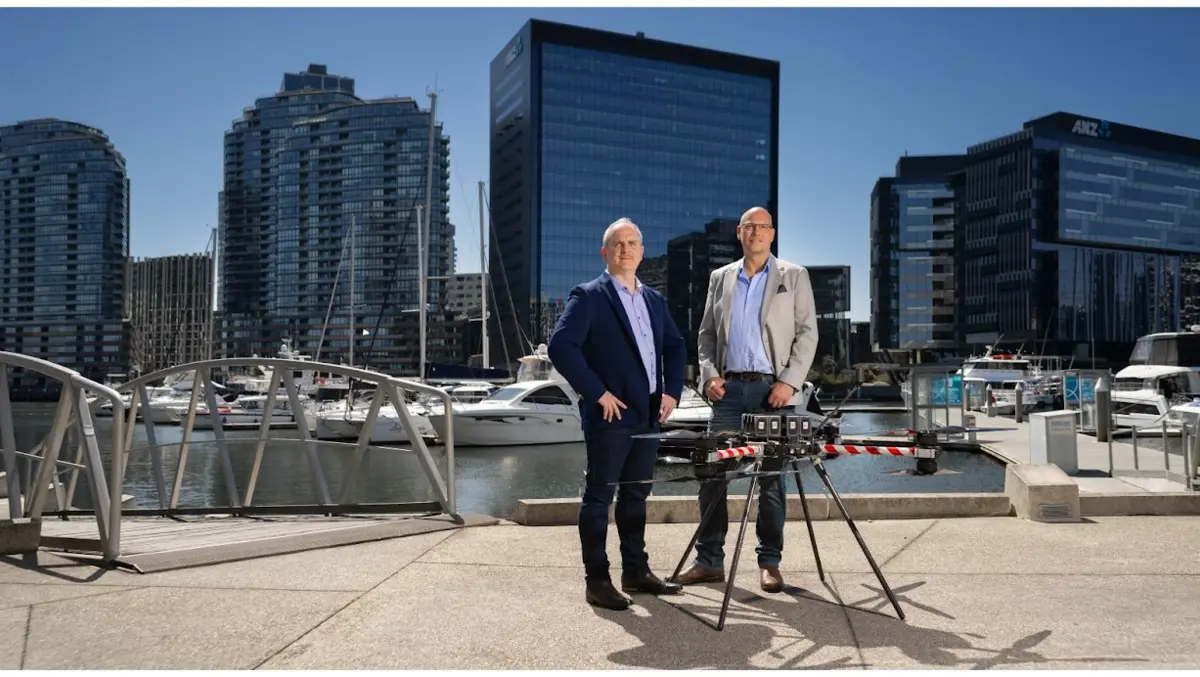
Australian drone breakthrough enables fourfold heavier payloads
Tue, 14th Oct 2025
Freespace Operations has developed a new technology that enables multiple heavy-lift drones to combine their efforts and carry much heavier payloads than previously possible for single aircraft.
The Australian company's 'Cooperative Lift' system allows its Callisto 50 drones to carry up to 100 kilograms by flying in synchrony, a payload four times greater than one Callisto 50 drone can manage alone. This technical achievement has already led to a multimillion-dollar contract with an international defence customer located in the Asia-Pacific region.
Solving the challenge
Freespace Operations Co-founder Ken King described the accomplishment as a major step for the drone industry, which has long sought the ability for multiple drones to work together on heavy-lift tasks.
"Whilst we're used to seeing drones fly in patterns for light shows, getting them to physically work together to carry weight is a completely different challenge, that we call Cooperative Lift. Universities and leading drone manufacturers worldwide have tried for years to solve Cooperative Lift with limited success," said Freespace Operations Co-founder Ken King.
King said the technology delivers a significant boost to the flexibility and capability of drone fleets, allowing them to tackle tasks that have until now required helicopters or custom-designed large drones.
"Our breakthrough proves it can be done safely, reliably, and at scale. We can now multiply the lifting power of a single drone up to four times while retaining all the flexibility of smaller, modular systems. This development will significantly increase the range of tasks that can be assigned to drones in a variety of heavy industry and defence applications. Whether it is carrying supplies to a moving ship, mineral exploration, mining logistics, stringing new power lines, or delivering life-saving supplies in an emergency situation, this breakthrough will mean our customers can get more done with their drone fleets than ever before."
Expanding operational potential
Since its founding in Melbourne in 2019, Freespace Operations has built a record of supplying heavy-lift drone solutions for government, defence, and industrial clients, including winning 29 contracts with the Australian Government and Defence worth more than AUD $9 million. The company has also carried out projects with infrastructure companies such as Infravision and Enerven.
Cooperative Lift follows Freespace's development of its Ship Ops technology, which was demonstrated in ship-to-ship and ship-to-shore logistics exercises using the Callisto 50 drone. These technological advances enable drones to undertake logistical operations that have traditionally required manned helicopters, contributing to both operational efficiency and risk reduction for human pilots.
The new capability offers the potential to transfer routine or hazardous logistic operations from helicopters to drones, freeing up manned aircraft and pilots for other tasks and reducing costs. Drones equipped with Cooperative Lift may be used for transporting cargo in hostile or difficult-to-access environments, for infrastructure projects, or during emergency responses when speed and flexibility are critical.
The technology foundation
The technical solution is built on the Callisto 50 drone, a heavy-lift platform designed and manufactured in Australia. The system incorporates hardware and control software developed by Freespace Co-founder and Chief Technology Officer, Leonard Hall. This control software coordinates the flight parameters and payload distribution across multiple drones, overcoming complex challenges such as shifting loads, environmental factors, and flight dynamics.
"Cooperative Lift was an incredibly difficult technological challenge, both from a hardware and software perspective. Because the Callisto 50 is already one of the most capable and reliable platforms in its class, we were able to unlock Cooperative Lift by building on a proven system that we knew was capable of being scaled in this way. It might seem intuitive at first, but accounting for all the different variables of flight across two or more drones is no small feat. The movement of the weight, and of course the wind and weather, make it one of the most difficult challenges in drone flight. We are immensely proud to bring this capability online, a world first in our industry." concluded Freespace Co-founder and CTO Leonard Hall.
The company states that this new capability extends the possible applications of its drone systems across defence, mining, infrastructure, and emergency services sectors. The development is positioned to alter current logistics strategies for both public and private sector clients across the region.