

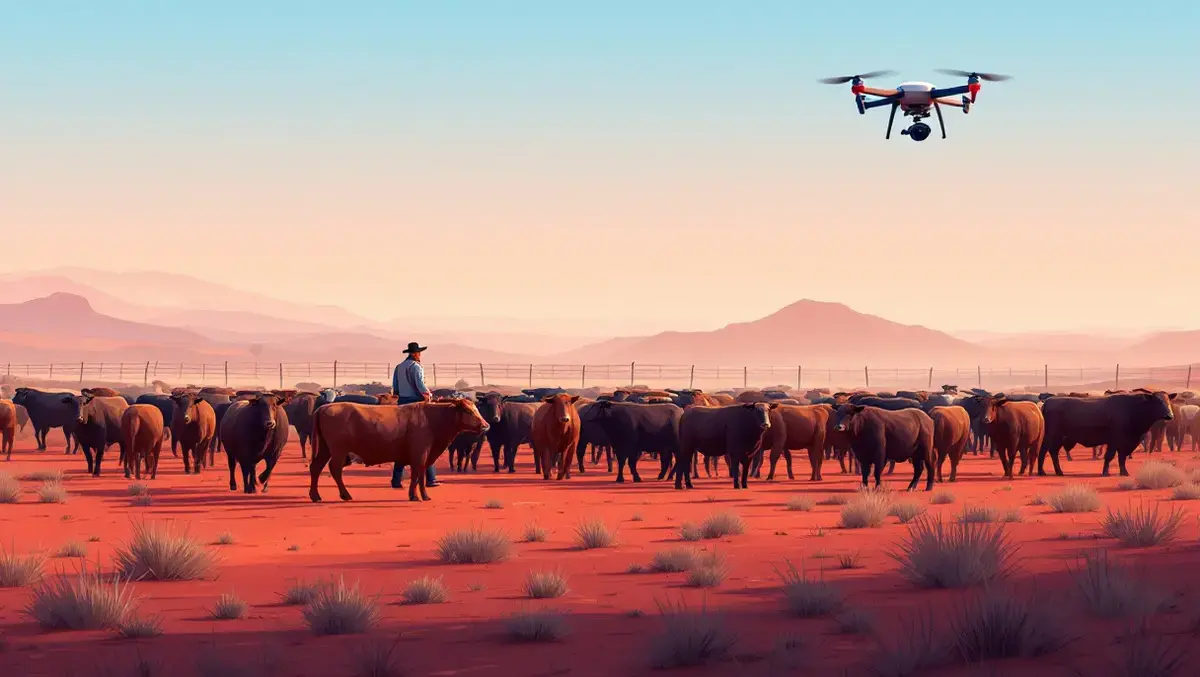
SkyKelpie trials autonomous cattle mustering in Queensland
Wed, 1st Jul 2026
SkyKelpie has demonstrated autonomous livestock mustering in paddock trials in Queensland, in work carried out with Meat & Livestock Australia and the Queensland Department of Primary Industries.
The trials tested livestock herding algorithms first developed in a simulation environment before being applied in field conditions across south-east and north-west Queensland. The results showed autonomous livestock movement was technically achievable under certain conditions.
The project combines computer vision, simulation tools and autonomous systems with livestock management. It also marks a step toward moving drone-based herding from experimental work into practical use on grazing properties.
Founded by fourth-generation grazier Luke Chaplain, SkyKelpie focuses on drone-enabled livestock management and aerial stockmanship training. More than 600,000 head of livestock are now managed by its customers across Australia.
Chaplain said the latest trials built on work that began with small drones on his family's property near Cloncurry in north-west Queensland.
"It's remarkable to see how far we've come from those early days testing what was possible, to now supporting producers across the country with tools that are genuinely changing the way livestock are managed," said Luke Chaplain, Founder, SkyKelpie.
"Seeing livestock herding algorithms move from simulation into real-world trials is a significant milestone, not just for SkyKelpie, but for the future of livestock management more broadly," he said.
From simulation
The field work reflects a wider push in agriculture to apply automation to repetitive and labour-intensive tasks. The trials were designed around livestock movement principles rather than treating animal handling as a purely technical exercise.
That distinction matters in grazing systems, where terrain, weather, animal behaviour and welfare concerns can alter the outcome of a muster. The trial also reinforced the limits of automation in situations that still depend on the observation and timing of experienced workers.
According to SkyKelpie, effective livestock management involves more than moving animals from one point to another. Human judgement remains important in deciding how stock should be moved, when pressure should be reduced and how paddock conditions should shape the approach.
Chaplain said that lesson had become clearer as artificial intelligence tools were tested in commercial grazing settings.
"Our experience shows that commercialising AI in grazing is proving to be more about restraint than outright replacement," he said.
"AI is becoming an incredibly powerful tool, but good stockmanship remains a highly human skill built around observation, timing and judgement. We see technology as something that should support graziers, not replace them," Chaplain said.
Broader tasks
SkyKelpie said the same technology base could be applied to other repeatable farm jobs beyond mustering, including livestock headcounts, pasture and biomass analysis, infrastructure and water monitoring, fence-line inspections and pest identification.
Automation may reduce time spent on routine checks and free up producers for planning and higher-priority work. In remote grazing operations, where labour availability and travel time can be major constraints, that prospect could interest producers looking for practical ways to monitor large properties.
SkyKelpie is also using artificial intelligence in its customer support systems. It recently launched a customer portal with AI-based support and troubleshooting tools intended to help producers in rural and remote areas find information and solve problems more quickly.
The collaboration with Meat & Livestock Australia and the Queensland Department of Primary Industries places the trial in a broader agricultural research setting. Australia's grazing sector is under pressure to improve productivity while managing labour shortages, animal welfare expectations and the demands of large, often isolated operating environments.
Drone mustering has already gained traction in parts of the cattle industry, particularly in northern Australia, where distances are long and conditions can be difficult. The latest trial suggests the next stage may involve partial automation, though SkyKelpie's own assessment is that human involvement will remain central.
For now, the significance of the Queensland trials lies less in replacing stockhandlers than in showing that simulation-based herding algorithms can work beyond the laboratory. "We see technology as something that should support graziers, not replace them," Chaplain said.