

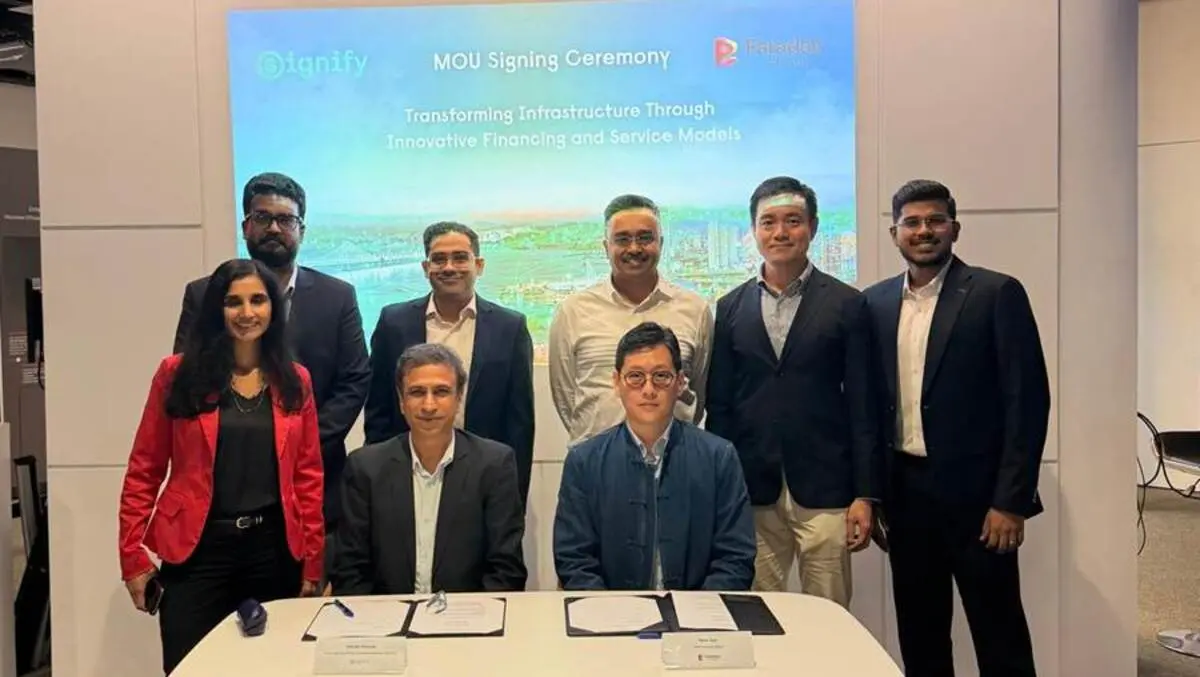

Signify Singapore and Faraday Energy have signed a memorandum of understanding to pursue Light-as-a-Service and Infrastructure-as-a-Service projects across Asia Pacific, initially focusing on buildings and data centres.
The agreement combines Signify's lighting systems and connected lighting platform with Faraday's capabilities in project evaluation, commercial structuring, financing and asset ownership. Under the model, customers can upgrade or retrofit lighting without upfront capital expenditure and instead pay a fixed monthly fee under contracts lasting five to 10 years.
The arrangement is aimed at organisations seeking to replace older lighting infrastructure while preserving capital for other uses. It also reflects growing demand among building owners and data centre operators for lower energy use, greater operational visibility and less disruption during upgrades.
Signify will provide lighting technology, connected systems and application expertise, including solutions linked to its Interact platform. Faraday will develop the commercial structure behind the service model and lead long-term financing.
The companies will work together to identify customer opportunities, design technical and commercial proposals, manage implementation and support the performance of installed systems over the contract term.
Service model
Light-as-a-Service has emerged as a financing approach for companies seeking to shift equipment spending into operating expenditure. In this case, the model is centred on lighting upgrades that can often be introduced in existing facilities with limited operational disruption.
This is particularly relevant in sectors such as data centres, where operators are under pressure to reduce energy consumption and maintain uptime, and in commercial buildings, where owners often face competing demands on capital budgets. A service contract can allow operators to move ahead with energy-related upgrades without waiting for a conventional procurement cycle for owned assets.
Faraday, a platform owned by Seraya Partners, provides Infrastructure-as-a-Service across sectors including buildings, data centres, and power and grid in Asia Pacific and Gulf markets. Seraya has more than USD 4.5 billion in assets under management and focuses on infrastructure linked to digital networks and the energy transition.
Signify, which reported EUR 5.8 billion in sales in 2025, operates in more than 70 markets and has a portfolio that includes professional lighting and connected systems.
Commercial pressure
The partnership comes as owners of large facilities weigh energy savings against the cost of replacing legacy systems. Lighting is often viewed as an early target for efficiency projects because retrofits can be deployed relatively quickly and paired with monitoring tools that give operators more data on usage and performance.
Jitender Khurana, Chief Executive Officer, Professional Business, Southeast Asia and Far East, Signify, said: "For most building owners, lighting is one of the quickest and lowest-risk places to start decarbonizing, yet upfront capital is often what holds projects back. By combining Signify's connected lighting and Interact platform with Faraday's long-term infrastructure capital, customers in buildings and data centres can modernize their lighting, pay for the outcome rather than the hardware, and start saving energy from day one. We see this partnership as a practical way to help our customers and the region accelerate sustainability goals."
Peter Goh, Chief Executive Officer, Faraday Energy, said: "Signify is the world leader in lighting and constantly innovating to provide smarter and more energy-efficient illumination. This partnership combines our capital and Signify's technology to bring true value-add to end-users."
James Chern, Managing Partner and Chief Investment Officer, Seraya Partners, said: "Many customers recognise the need to replace ageing, inefficient infrastructure, but competing capital priorities can delay implementation. The partnership between Signify and Faraday is closely aligned with Seraya's strategy of building scalable infrastructure platforms that deliver operational value and measurable sustainability outcomes."