

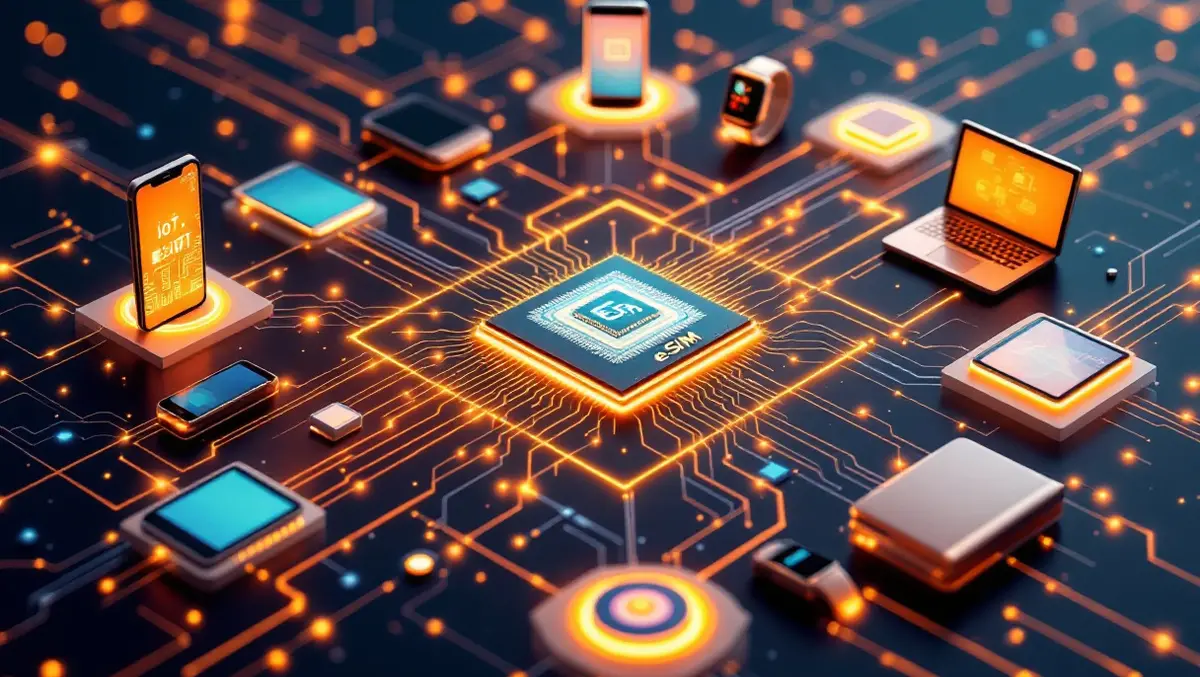
Pelion launches Consumer eSIM for IoT to enhance connectivity
Wed, 24th Sep 2025
Pelion has introduced its Consumer eSIM for IoT, offering connectivity solutions aimed at businesses by taking advantage of the increasing adoption of consumer eSIM chipset technology in various devices.
Expanding use of eSIM technology
The new Consumer eSIM for IoT service is designed to address business challenges in deploying and managing connected devices across both consumer and commercial sectors. The solution leverages advancements in eSIM technology as well as the widespread availability of consumer eSIM chipsets.
Historically, advanced chipsets found in premium smartphones and wearables have now become widely accessible as commodity products and are found not only in mass-market consumer devices but also in a range of commercial and enterprise equipment, including network hardware, point of sale terminals, digital signage, and vending machines.
With its Consumer eSIM for IoT, Pelion seeks to harness the broader diffusion of these chipsets to offer secure and scalable connectivity services. The company's solution combines IoT-grade connectivity with established consumer eSIM mechanisms, enabling rapid deployment, stronger security through non-removable eSIMs, and flexibility for businesses operating across different geographies and industries.
Dave Weidner, CEO at Pelion, said, "This launch comes at a critical inflection point for the industry. As chipset technology becomes commoditised, innovations from yesterday's cutting-edge chipsets – such as Bluetooth, wi-fi or cellular – are built in at the silicon level. This includes Consumer eSIM, which has been adopted today by mobile network operators and travel SIM companies as the global standard for flexible, connectivity delivered digitally."
He continued, "We are leveraging this critical juncture to provide organisations with the flexibility to connect their devices, delivering connectivity that's faster to deploy, easier to manage and built for scale."
Centralised management and deployment
The eSIM solution offers businesses centralised management tools and facilitates instant digital deployment, including options for activation via QR codes for small-scale rollouts. Larger organisations can take advantage of integration with Mobile Device Management (MDM) platforms as well as device management solutions that are tailored to specific industry requirements.
Dave Weidner added: "This approach aligns with where eSIM is headed: seamless remote provisioning and lifecycle management across diverse device fleets."
Industry trends and future outlook
Pelion's launch is set against the backdrop of significant changes in the consumer device industry. Notably, recent product releases by Apple have seen certain new models of the iPhone offered exclusively with eSIM technology in several international markets. This development signals a likely shift away from physical SIM cards among major consumer device manufacturers, with expectations that more providers will follow this direction.
While these developments suggest that physical SIM cards may be phased out of new consumer devices such as smartphones, tablets, and wearables, Pelion expects this shift will not extend universally to more traditional IoT deployments. The requirements for many commercial IoT installations often differ substantially from consumer devices.
Weidner said, "Many commercial IoT deployments have very different requirements to the tech where we're seeing the adoption of consumer eSIMs. Traditional IoT devices may be installed in hard-to-reach locations, constrained by limited battery life, designed for long lifecycles, or built to operate in harsh environments. In these cases, a traditional SIM or an IoT-specific eSIM is still the most practical and cost-effective choice."
He continued: "That's why our Consumer eSIM for IoT is an expansion of choice, not a replacement. Businesses with existing IoT deployments should feel confident that devices with physical SIM slots will continue to be supported with Pelions eUICC IoT SIM offering, with no risk of near- or mid-term obsolescence due to connectivity standards."