

Millibeam wins award for lightweight counter-drone system
Thu, 8th Oct 2026 (Today)
MILLIBEAM has won the Emerging Technology Award at the Land Forces 2026 Innovation Pitchfest and Awards for its RAKURAI counter-drone system. The award recognises products judged to meet customer needs, demonstrate innovation and offer a viable market.
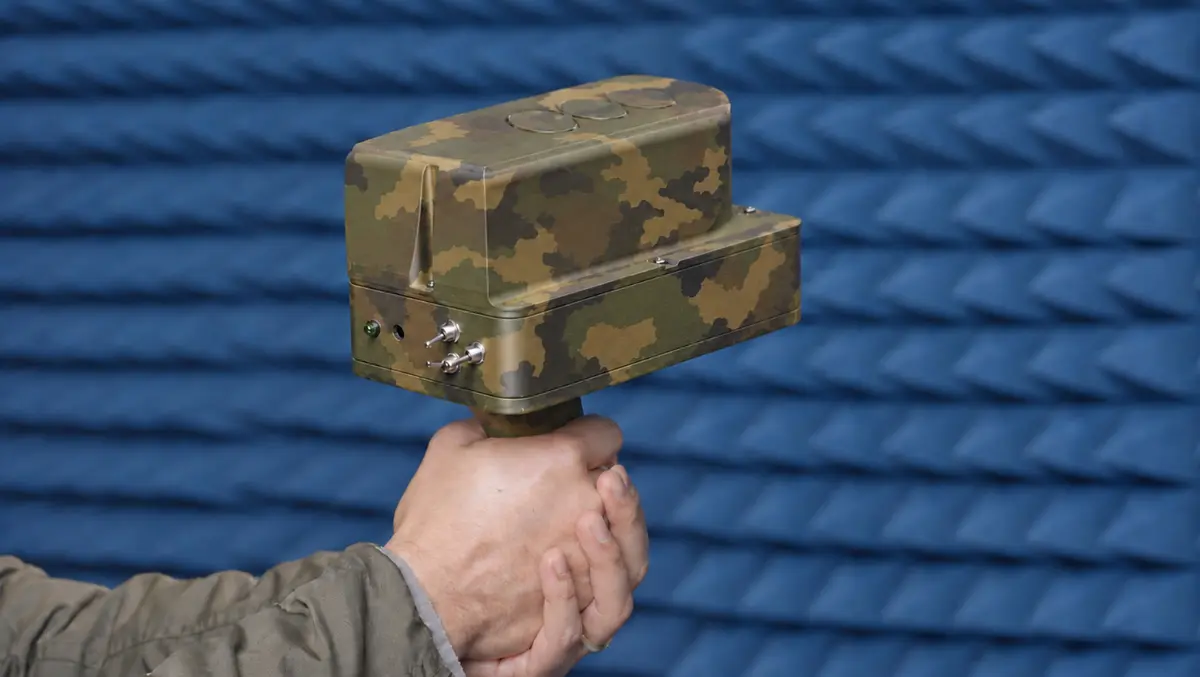
RAKURAI is a handheld counter-uncrewed aerial system designed for individual soldiers rather than a single specialist at platoon level. Developed in Australia using MILLIBEAM's own radio frequency architecture, it is intended to address what the company describes as a gap in section-level protection against small drones.
Drone attacks have become a growing concern for armed forces and domestic security agencies, with small, relatively cheap systems increasingly used on the battlefield. MILLIBEAM cited Western estimates that drones now account for 70 to 80 per cent of military casualties in the Russia-Ukraine conflict, underscoring pressure on defence organisations to equip troops with portable countermeasures.
Existing handheld systems are often too heavy and too expensive to issue widely, according to MILLIBEAM. Current dismounted counter-drone systems usually weigh between 2kg and 7kg, run for less than an hour and are typically assigned to one operator responsible for protecting up to 30 people.
That creates a vulnerability if the operator is separated from the unit or unable to keep using the system. RAKURAI is intended to shift that model by making a lighter unit available to individual soldiers.
MILLIBEAM said the device weighs less than 1kg, operates continuously for more than two hours, has an effective range of more than 1km and covers frequencies from 0.4 to 6 GHz. It attributed those specifications to an integrated design process that developed chips, antennas, power electronics and signal processing together, rather than assembling the product from off-the-shelf components.
Military demand
The product enters a market where governments are increasing spending on counter-drone systems. In Australia, Project Land 156 has prioritised sovereign counter-uncrewed aerial systems for the Australian Defence Force, while Mission Syracuse is seeking responses to small uncrewed aerial threats.
These programs sit alongside a Federal Government commitment of AUD $7 billion to counter-drone defence. Internationally, US Army doctrine has also shifted responsibility for countering small drones towards every soldier and unit, broadening the potential market from one system per platoon to one system per soldier.
MILLIBEAM also sees demand beyond defence. The company said first responders and operators of critical infrastructure face similar risks from unauthorised or hostile drones, expanding the addressable market for portable systems.
Research and Markets has forecast the global counter-UAS market will reach US$29.70 billion by 2031, driven by the spread of drone threats across military and civilian settings. For suppliers such as MILLIBEAM, that creates an opening for products aimed at users who need lower weight and lower cost than existing field equipment often offers.
The company said RAKURAI has reached Technology Readiness Level 6, generally associated with prototype demonstration in a relevant environment. That places the product beyond early concept work but still short of full-rate operational deployment.
Dr Venkata Gutta, Founder and Chief Executive Officer of MILLIBEAM, said the design approach was central to whether handheld counter-drone systems could be fielded in large numbers.
"Putting counter-drone protection in every soldier's hands raises two questions: can they carry it, and can the force afford tens of thousands of units? The answer comes down to how the system is built, and designing from the semiconductor chip up, here in Australia, solves both," said Dr Venkata Gutta, Founder and Chief Executive Officer of MILLIBEAM.
He said the award recognised the company's focus on a gap that has become more pronounced as drones have spread across the battlefield.
"The threat has scaled to every soldier, and we believe protection must too. We are honoured to receive this industry recognition because it validates our work to close the section-level counter-drone gap," Dr Gutta said.