

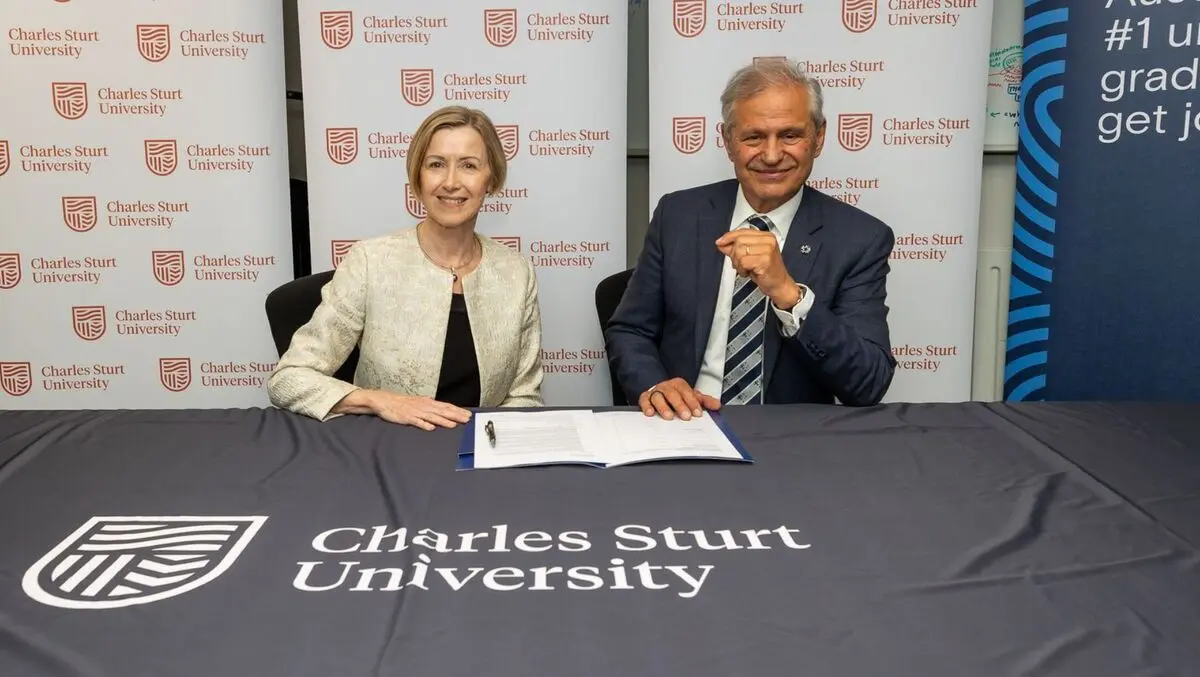
Charles Sturt, ASII build digital agriculture platform
Mon, 26th Oct 2026 (Today)
Charles Sturt University and the Australasian Space Innovation Institute have formed a partnership to build digital infrastructure for Australian agriculture, starting with a AUD $465,000 project backed by Meat & Livestock Australia.
The work combines Charles Sturt's Australian Agricultural Data Exchange with ASII's National Digital Twin for Agriculture Program. The aim is to create a shared digital foundation that links agricultural data, research models, satellite observations and artificial intelligence so they can be accessed and reused more easily.
Rather than creating a single digital twin for the sector, the partners plan to develop the underlying systems from which multiple digital twins, research tools and decision-support services can be built. They say this approach will allow researchers, agritech companies, research and development corporations, industry groups and government agencies to use common data and modelling elements without rebuilding them from scratch.
Charles Sturt's data exchange is expected to provide access to agricultural datasets and services covering soils, water, weather and climate. ASII will contribute expertise in satellite technology, geospatial analysis, artificial intelligence and modelling.
The infrastructure could support a range of uses, including placing trial results in different environmental contexts, running virtual experiments before physical field trials, and testing research models across locations, seasons and climate conditions.
The project enters a sector where large sums are already spent on research and development. The partners say about AUD $3 billion is invested in Australian agricultural research and development each year, yet less than five per cent of potentially useful data is analysed to generate new information.
The partnership is intended to address that gap by making existing data easier to connect and apply. Charles Sturt and ASII are also identifying further use cases for agriculture and other industries as the infrastructure takes shape.
The first funded project will test and validate the platform through two case studies. One will focus on cattle and pasture management at Charles Sturt's Wagga Wagga campus, using virtual fencing and automated livestock weight data, together with weather information and satellite imagery, to identify suitable paddocks for cattle movement and pasture management.
The second case study will examine the spread of mimosa weed in the Northern Territory. It will use satellite imagery and historical farm data to predict where the invasive species is most likely to spread and where control measures can be directed.
The work will be delivered by researchers from Charles Sturt's Artificial Intelligence and Cyber Futures Centre together with ASII specialists. Additional use cases under consideration include water availability, virtual fencing and farm-scale natural capital assessments.
Professor Renée Leon, Vice-Chancellor of Charles Sturt University, said the initiative would improve returns from existing agricultural research spending.
"Every dollar invested in Australian agricultural research and development returns $8 in the next decade," Professor Leon said.
"This partnership will build the digital infrastructure that unlocks that return on investment and delivers tangible results for Australian producers.
"Our farmers and agribusinesses already have most of the pieces. This partnership will connect that data so that the investment keeps paying back, for landholders and for the nation as a whole."
Professor Andy Koronios, Chief Executive Officer of the Australasian Space Innovation Institute, said the program was intended to create shared systems rather than a single national model.
"We are not setting out to build a single digital twin of Australian agriculture. Our ambition is to establish the digital infrastructure that allows researchers, industry and government to connect and reuse data, models and analytical tools to address real-world challenges," Professor Koronios said.
"By bringing together satellite observations, agricultural data, research models and artificial intelligence, we can create new opportunities to explore 'what if' scenarios, test ideas and better understand the potential consequences of decisions before they are made.
"Our role is to build the foundations that others can innovate upon, not compete with the agtech or agribusiness industry. We want to enable better products, services and research outcomes, with benefits flowing through to Australian farmers via the tools, advisers and services they already use, rather than requiring them to invest in another technology platform.
"While agriculture is our initial focus, the underlying infrastructure will also have broader applications across climate, environmental monitoring and natural resource management."