

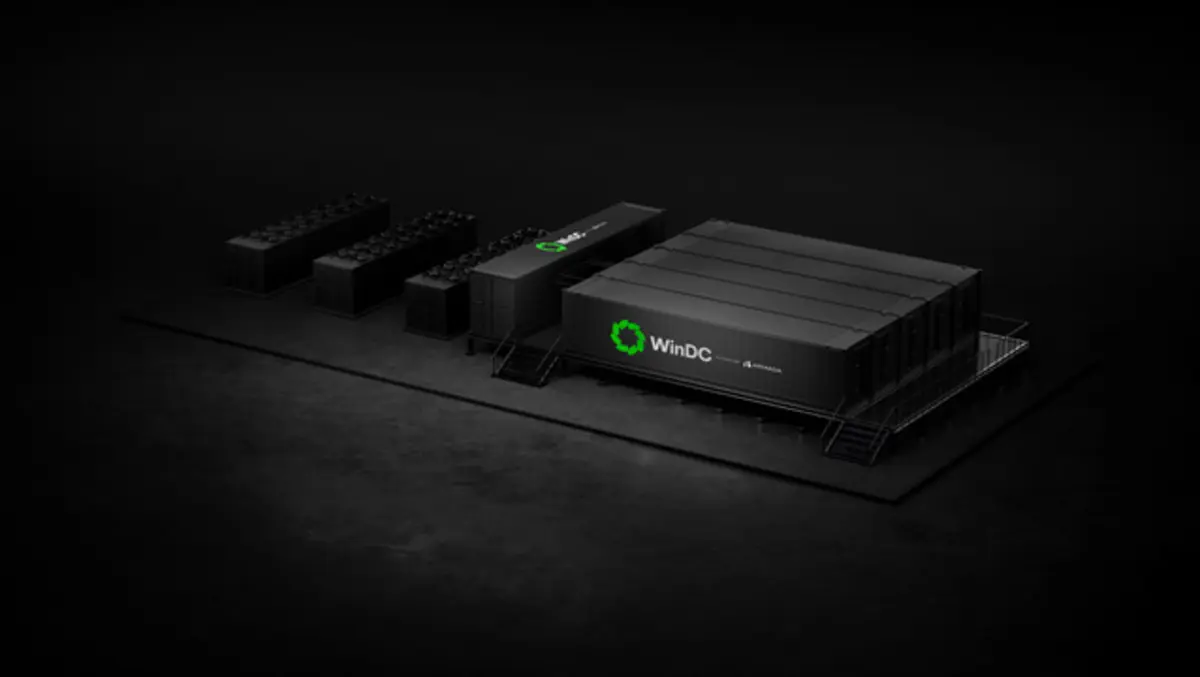
WinDC & Armada unveil USD $30 billion AI factories
Wed, 18th Nov 2026 (Today)
WinDC and Armada have unveiled plans for a US$30 billion network of AI factories across Australia and New Zealand as part of a US Government-backed technology export initiative.
The companies aim to build up to 3GW of AI computing capacity across about 40 sites by the end of the decade, starting with an initial 11MW deployment across five Australian states and followed by a further 230MW in 2027.
Armada has been named a Priority Team Leader under the American SI Exports Program, and WinDC's proposed Australian rollout has been included in its export plans. The program provides participating consortia with US Government advocacy, prioritised export licence processing, and referrals to federal financing agencies.
The announcement places an Australian infrastructure project within a broader US push to expand overseas deployment of American artificial intelligence systems and related hardware. For WinDC, it also connects domestic energy assets with a proposed computing network designed to serve local and overseas users.
Rollout plan
The model relies on modular AI data centres built at or near existing energy generation sites, including wind and solar facilities. WinDC says this would allow projects to be developed close to available electricity rather than in metropolitan data centre hubs, where grid constraints and longer construction timelines have become a challenge.
According to WinDC, Armada's Leviathan modular data centres provide up to 2MW of computing infrastructure per unit. The company is targeting deployment timelines of about 90 days in locations where sites, power access, and approvals are already in place.
Multiple facilities could then be linked through Armada's technology platform to function as a distributed computing network. The companies say the plan could eventually create a network spanning Australia and New Zealand, although the early stages are focused on Australian sites.
WinDC Chief Executive Officer Andrew Sjoquist said the arrangement represented external backing for Australia as a location for advanced computing infrastructure. "The US Government is backing the world's most advanced AI technology to be built here in Australia. That puts us at the front of the queue at a time when every nation on earth is competing for computing capacity."
He said the immediate target was to deliver the next tranche of capacity while preparing the broader build-out. "Australia has the energy, the land and the expertise to build an entirely new export industry. This deal gives us the backing to do it at speed. Our immediate focus is delivering 230MW of new capacity in 2027, while building towards a national network that could attract more than US$30 billion in investment by the end of the decade."
Energy link
A central element of the proposal is the use of generation that might otherwise go unused. WinDC cited figures in its agreement with Armada showing that more than seven terawatt-hours of utility-scale wind and solar generation were curtailed across Australia's National Electricity Market in 2025.
By locating data centre modules close to generation sites, the company argues it can use electricity that is available but not fully absorbed by the grid. That would also shift some data infrastructure investment away from large urban campuses and into regional areas with energy resources and land.
Sjoquist said the project could direct investment into those locations. "This is an opportunity to bring substantial investment into regional Australia, create economic activity around energy generation sites, and turn Australian energy into computing capacity that can be sold to customers around the world."
Export focus
The companies are presenting the network as an export business, not just a domestic digital infrastructure project. WinDC said the system could position Australia as a supplier of AI and SI computing services to markets across the Indo-Pacific.
It highlighted Western Australia in particular, arguing that the state's energy resources and subsea cable connections could provide access to Southeast Asia, India, and the Middle East. The company said markets in Southeast Asia with at least 500 million people are within about 50 milliseconds of computing infrastructure on Australia's west coast.
Sjoquist framed that as a shift in how Australian energy could be sold abroad. "For decades, Australia has shipped its energy overseas as raw resources. Now we can use that energy here, turn it into intelligence and sell it to the world - with Western Australia as the gateway to some of the fastest-growing AI markets on the planet."
US supply chain
Armada leads the American Sovereign SI Stack, a consortium that also includes Dell Technologies and Microsoft. The group combines Armada's modular data centres with Dell computing and storage systems and Microsoft's Azure Local and Foundry Local platforms.
WinDC and Armada said the proposed 3GW rollout represents total potential project investment of more than US$30 billion, including more than US$20 billion in US-manufactured Armada infrastructure. The companies also said they intend to explore possible financing support for future deployments, including through the Export-Import Bank of the United States.
The plan shows how AI infrastructure is becoming increasingly tied to industrial policy, export finance, and energy strategy as countries compete for access to computing resources. It also underlines how regional power markets, grid bottlenecks, and transnational supply chains are shaping where large-scale AI systems are built.